How are the South African crime stats crimes compiled?
Every year, the South African Police Service (SAPS) releases crime statistics for the financial year from 1 April to 31 March the following year. These statistics provide an indication of whether key crime categories are increasing or decreasing nationally, provincially, or across all police stations.
In recent years, the SAPS has also released quarterly crime statistics four times per year. These statistics provide a snapshot of crime on a specific date for a specific quarter and are not directly comparable with the annual statistics.
The police station data can be aggregated at a local municipal level to understand the public safety challenges better and guide the types of interventions needed. In addition, the continuous time series of the national, provincial, station, district or municipal-level crime statistics is used to provide longitudinal trends of selected crimes. Figure 1
summarises the categories and breakdown of SAPS crime statistics nationally.
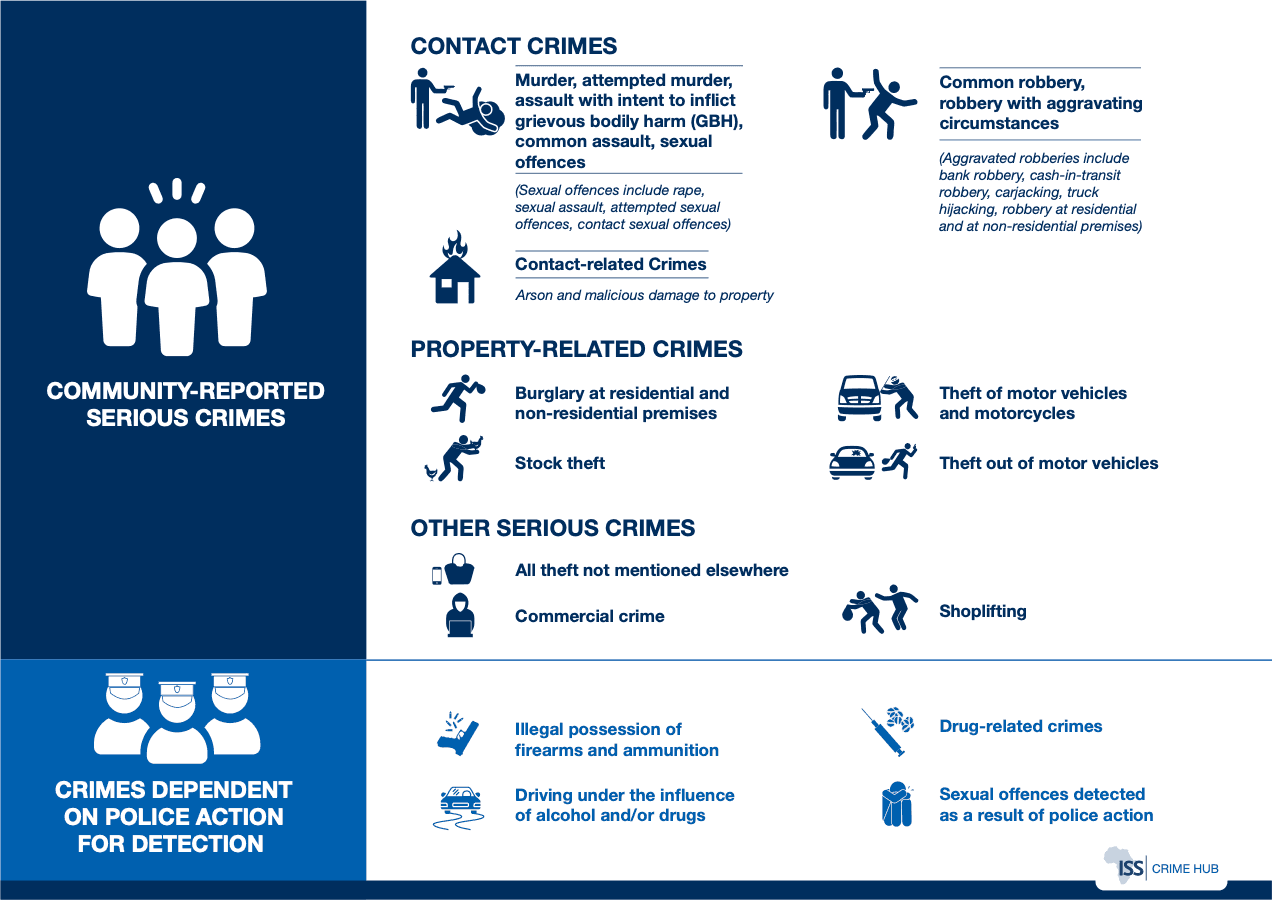
Contact or violent crime comprises about 41% of serious crimes reported to the police (also known as ‘community-reported serious crimes’). Contact crimes include interpersonal violent crimes such as murder, attempted murder, and all forms of assault, including sexual offences.
Another type of violent crime is violent property-related crime, which in turn consists of two main crime categories. The first is common robbery, which is the violent removal of property from a person through force, harm, or the threat of harm. The second is robbery with aggravating circumstances, also known as armed robbery, because a weapon is used, most often a firearm or knife.
Armed robbery – is broken down into further sub-categories in terms of location. These include robbery at non-residential premises (mainly small businesses), robbery at residential premises and carjacking. These three are the so-called ‘trio crimes’, which are prioritised by the police and the National Prosecuting Authority (NPA).
Other subcategories include truck hijackings, bank robberies, and cash-in-transit robberies. Most armed robberies are thought to happen to civilians on the street or in other public spaces (‘street robberies’), but the police do not release figures for this crime category.
The police category of property-related crime includes residential and non-residential burglary, as well as theft of and out of motor vehicles. This makes up 24% of serious ‘community-reported crime’.
‘Other serious crime’, mainly types of theft (such as stock theft, shoplifting and commercial crime), makes up 27%. Contact-related crime (arson and malicious damage to property) is the smallest sub-category at eight percent.
Crime detected as a result of police action consists of cases stemming from roadblocks and other police operations resulting in the detection of drug-related crimes, driving under the influence of drugs or alcohol, the discovery of illegal firearms and ammunition, and, since 2011/12, the detection of sexual offences. These figures are thus determined by police action as recorded by the police and not by community members and are therefore not a measure of the actual incidence of the crime category.
Most crimes in the overall category of crime detected as a result of police action are drug related. This is because many police operations target those selling and buying drugs. However, the actual levels of drug use and distribution are generally understood to be mostly unaffected by police action. As a result, changes in these figures should not be used as an indicator of the availability of drugs per se or of the size of the market. Figures on driving under the influence may also reflect levels of police action rather than the scale of the problem.
Do police crime statistics provide a complete picture of crime?
Official police crime statistics provide a snapshot of crime in South Africa as reported to and recorded by the police. Many crimes are not reported to the police and therefore do not appear in the crime statistics. Whether a crime is reported to the police is influenced by a range of factors, for example whether victims need a case number for insurance purposes, whether they believe the crime is serious enough, or whether they believe the police will find the stolen goods or arrest the perpetrator. Furthermore, the released crime statistics focus on those crimes that are serious and violent in nature.
Why is understanding police precinct-level analysis important?
Each police station should investigate its own hotspots and the drivers of high murder rates. Localised neighbourhood hotspots differ considerably, since the various drivers of murder (e.g. gang-related violence, taxi-related violence or vigilantism) do not apply everywhere.
However, international and national research shows that violence against women and children (GBV) is universally driven by intimate partner violence. Therefore, some drivers do share common factors, such as GBV and other forms of interpersonal violence such as assaults due to arguments.
Understanding this uniqueness is essential when planning a response. The implementation of the 2016 White Paper on Safety and Security not only seeks to address some of the drivers but also aims to enhance safety planning partnerships and processes. Municpalities will benefit from the implementation of the White Paper, since safety audits, for example, will attempt to address the safety needs of communities in the municpalities.
Furthermore, it is an unusual situation globally to have declining assault rates but increasing murder rates. It is, therefore, important to keep in mind that nearly half of all assaults nationally are not reported to the police, according to the 2019/20 National Victims of Crime Survey. This may mean that the declines reported by the police are overstated. Changes in police statistics may thus reflect crime reporting trends rather than actual crime trends.
The same problem exists with sexual offences, most of which are rape cases. As with assaults, most victims and survivors of this crime do not report the offence because of a lack of trust in the police, or due to concerns over stigmatisation of themselves or their families.
How does the SAPS collect crime data?
The SAPS annually collects and disseminates statistics on crimes recorded at the 1,164 police stations in South Africa. The crimes recorded by the SAPS include those reported by victims, witnesses, or third parties and those detected by police officials. The data collection process begins with an incident of an alleged crime being assessed for its unlawfulness, after which it is classified.
A crime incident is recorded in a case docket, which is entered into the SAPS’s Investigation Case Docket Management System (ICDMS) and the Crime Administration System (CAS). Crimes are grouped into the various broad categories listed in Figure 1. These are the categories of crimes for which official figures are currently released for public use and not an exhaustive list of all crimes recorded by the police.
Are crime statistics accurate?
Police statistics are not considered a scientific or objective measure of all the crimes that occurred in a given location and time period. Instead, they represent a data collection process that is designed to assist a law enforcement organisation in the practical execution and evaluation of its duties. SAPS crime statistics should always be qualified as ‘crime statistics as reported by the police’. This is important to note, as many crimes are not reported to the police and therefore do not appear in the crime statistics.
Whether a crime is reported to the police is influenced by a range of factors, including:
- Victims’ and witnesses’ understanding of which kinds of incidents are appropriate matters for police attention versus interpersonal, family or community resolution
- Victims’ and witnesses’ interpretation of the various parties’ legal rights and responsibilities (i.e., do they think that a crime or unlawful act has occurred)
- Victims’ and witnesses’ willingness or ability to initiate an official legal process following what may already have been a traumatic incident
- Victims’ and witnesses’ ability to access police services and produce an accurate written record of the event
Generally, individuals with relatively high levels of wealth and education and who have an expectation of personal safety, insurance policies on their goods, and a sense of trust in the police are more likely to report a criminal incident that they experienced as a victim or witness. The crimes experienced by poor, vulnerable or marginalised individuals are far less likely to be reported to or recorded by the police.
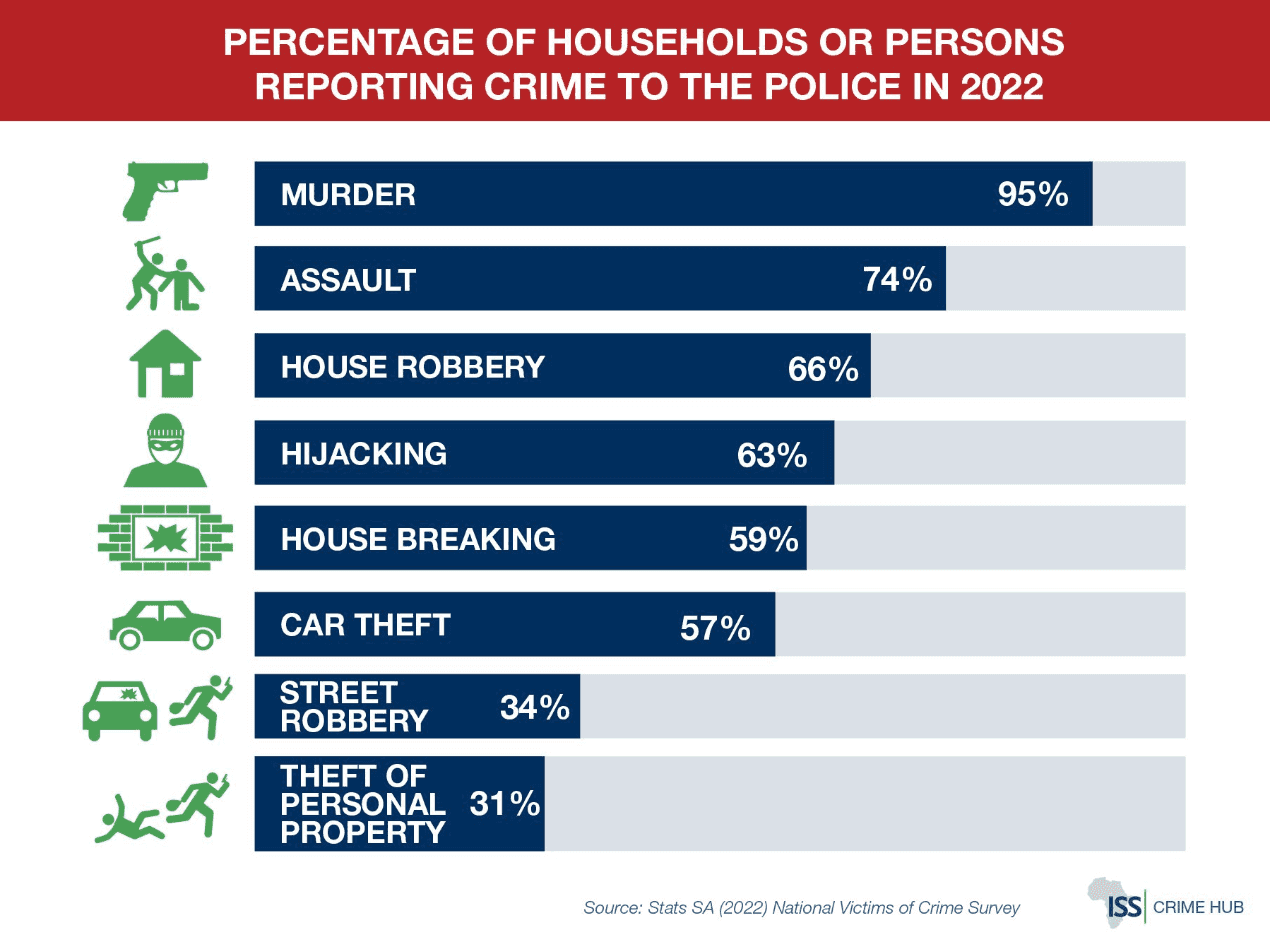
Consequently, different categories of crime have different levels of reliability or validity as an indicator of actual crime levels. For example, surveys suggest that a vast majority of motor vehicle thefts in South Africa are reported to the police. This is because victims need an official case number to claim insurance on a stolen vehicle. However, only half of residential burglaries are reported to the police, as most victims do not have household insurance, or believe that the police will not or cannot do anything to help them.
Such differences in reporting rates can produce crime statistics that give a highly distorted impression of crime prevalence, distribution, or trends.
How can we get a complete crime picture?
Crime statistics should always be interpreted in the context of independent survey data on crime experiences and reporting, such as that provided by Stats SA in its annual National Victims of Crime Survey (VoCS). It is particularly useful to conduct a methodologically robust district- or municipal-level survey.
An additional difficulty in analysing crime statistics is that crime reporting rates are not evenly distributed across any country, district/municipality, neighbourhood or even household. Moreover, statistics for crime categories do not provide sufficient insight into the nature of the crime risk or threat.
For example, knowing the number of murders and trends says nothing about the victims, perpetrators, specific localities or causal factors driving murder. It is thus important to conduct analyses of the levels and drivers of crime at the smallest geographical scale possible.
The best that can be done with the available SAPS crime data is to generate municipal-level crime statistics, which in and of itself requires certain technical work such as analysis of where, when and how specific crimes occur. This is because the SAPS do not release crime statistics for districts and municipalities.
Why should we look at the murder rate in a district, municipality or city?
The murder rate is the most accurate indicator of violence levels because most cases are recorded by the police. South Africa has one of the highest murder rates in the world, at 45 murders per 100,000 population in 2023 and 2024. The global average is under six murders per 100,000 population. The murder rate is often used to compare violence levels between areas, cities, countries, and regions.
Different countries, provinces, municipalities, districts and police stations have different population sizes. It is important to take the population size into account before comparing different areas.