Factsheet: Risk and trend analysis
Killing for office
Political killings and public violence ahead of South Africa’s 4 November 2026 local elections
Political killings are now the single largest cause of death in South Africa’s record of protest and public violence. Between May and October 2026, 34 people were killed in 26 attacks on councillors, candidates, party members, civic leaders and a traditional leader – more than half of all deaths recorded by the monitor. The killings have come in three waves that follow the electoral calendar, the latest in the final campaign fortnight. This report sets out who is being killed, where and how, and what that means for voting day and the formation of councils after it.
Situation overview
The principal lethal risk on and around voting day is targeted and small-group armed attacks on candidates, party agents, campaign teams and gatherings, rather than mass disorder. The pattern points to continuing danger during seat allocation, coalition bargaining and council formation after polling day.
Key findings
- Political killings caused 34 of the 64 deaths (53%) recorded by the ISS Protest and Public Violence Monitor between 1 May and 28 October 2026. Mob justice caused a further 23. Almost no one has died at a protest march.
- The killings came in three waves matching the electoral calendar: voter registration in June, candidate selection in August–September, and the final campaign in October. The week of 12 October was the deadliest of the cycle, with eight political deaths.
- In October the pattern widened from single assassinations to attacks on groups engaged in political activity – mourners in Katlehong, canvassers in Umgababa and an anti-immigration gathering in Dunoon.
- Victims span nine affiliations. The ANC has lost the most people (15), followed by the IFP (4) and the DA (3). The perpetrators’ affiliations are unknown in almost every case.
- KwaZulu-Natal and Gauteng account for 56% of political deaths, but killings are now recorded in seven provinces.
- An arrest or charge has been publicly reported in only four of the 26 cases.
- The anti-migrant mobilisation re-escalated in October after a quiet August and September. 510 soldiers have been deployed in KwaZulu-Natal until 30 November to support the police.
Recommendations at a glance
- Protection should extend beyond voting stations to ward candidates in contested wards and party agents in transit. Most killings happen at victims’ homes and on the move.
- Memorials and funerals of political victims should be treated as high-risk gatherings.
- The army deployment in KwaZulu-Natal should be used to free police capacity for protecting candidates and investigating killings.
- The security posture should be sustained through council formation and mayoral elections after polling day.
- The Political Killings Task Team should publish an updated, case-by-case count of investigations and arrests.
- Prosecutions in the cases with suspects should be concluded and their outcomes publicised.
1. Introduction
South Africans vote in local government elections on 4 November 2026. This report draws on the ISS Protest and Public Violence Monitor (PPVM), which records protest and public violence from media and field reports, including incidents captured by IEC conflict coordinators. The extract analysed here contains 621 records.1
Since August, political killings have continued and have become the main cause of recorded deaths. They have also spread to new provinces and taken new forms. At the same time, the anti-migrant mobilisation that dominated June and July reduced in August and September before flaring again in October.
The report first analyses political killings and assassinations separately. It then sets out wider trends in public violence, identifies hotspots and assesses prospects for violence on voting day and after.
2. Political killings and assassinations
Defining a political killing
For this analysis, a political killing is a fatal attack on a person whose political, civic-movement or traditional-leadership role is the likely reason they were targeted, or which happened while the victim was engaged in political activity such as campaigning, registration work, a party meeting or a memorial. Each case was identified from the PPVM record and coded by ISS for victim role, affiliation and setting.
Motive has been established in very few cases. Inclusion reflects the victim’s role and the circumstances, not a finding that the killing was politically motivated. Police have said that, in at least one case, a political motive has not been confirmed.2 Three cases are borderline: that of Monica Dube, in which the accused is charged with robbery and murder; the activist Mokoena Letsie; and a headman in Mnquma. Leaving them out would reduce the count to 30 deaths in 23 events, but it would not change any finding.
Three waves tied to the electoral calendar
The PPVM records 34 deaths in 26 political killings between 1 May and 28 October 2026, or 53% of all 64 recorded deaths.1 Seventeen deaths occurred before 7 August and 17 after it, so the rate of killing has not slowed.
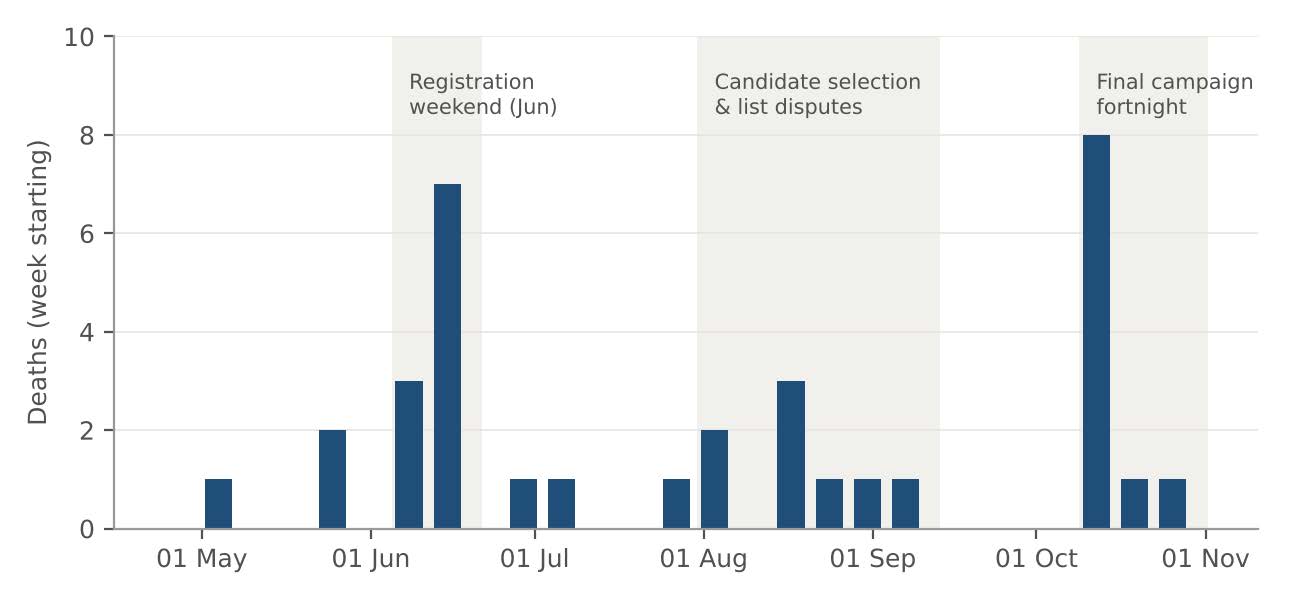
The waves coincide with the three moments when local office is most directly contested:
- Registration (8–21 June): 10 deaths in 8 events. Candidates and volunteers were killed returning from registration work: DA candidate Sinovuyo Dyokwe in Dunoon, BOSA candidate Leon Ngcikwe in Gugulethu and two MK Party volunteers in Bekkersdal. ANC councillor Sicelo Mleve was shot in his Zwide office.
- Candidate selection (6 August–8 September): 8 deaths in 7 events. Victims were mostly sitting or former councillors and confirmed candidates, including ANC councillor Khekhe Khwela in Klaarwater, former Knysna mayor Aubrey Tsengwa, and three IFP councillors or candidates killed within 12 days. In the same period, ANC and MK Party members protested publicly over candidate lists, which is a key grievance the Moerane Commission linked to political killings in KwaZulu-Natal.3
- Final campaign (13–26 October): 10 deaths in 5 events. Four ANC Youth League members were shot in Katlehong, a headman and his mother in Mnquma, two ANC canvassers in Umgababa, an SACP candidate in Dutywa and a DA candidate in Zamdela.
No political deaths were recorded between 9 September and 12 October. That lull fell between the settling of candidate lists and the final campaign push, and was followed by the deadliest week of the cycle.
The killings have come in three waves that follow the electoral calendar precisely.
Who is being killed
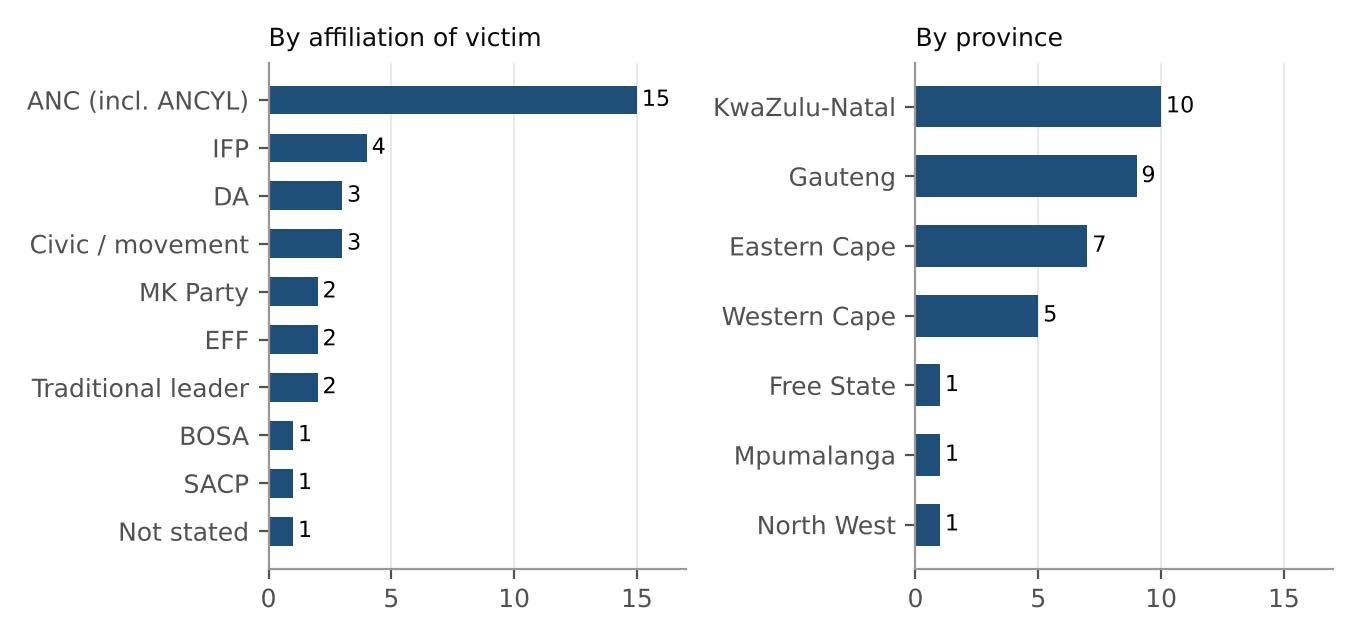
Fourteen of the dead were sitting or former councillors or confirmed candidates. Four were party officials or organisers, 11 were party members, volunteers or campaigners, three were civic or movement leaders, and two were a headman and his mother.
The ANC carries the heaviest toll (15 deaths), followed by the IFP (4) and the DA (3). The spread is across nine affiliations, namely the ANC, IFP, DA, MK Party, EFF, BOSA, SACP, a civic movement and traditional leadership. It is consistent with the Global Initiative Against Transnational Organized Crime (GI-TOC) finding that local office has become a resource worth killing for, irrespective of party.4 The perpetrators’ affiliations are unknown in almost every case, so it should not be assumed that victims of one party were attacked by another.
Where the killings occur
KwaZulu-Natal (10 deaths) and Gauteng (9) remain the two centres, together accounting for 56% of political deaths. The main concentrations are eThekwini (5 deaths in 4 attacks), the KwaZulu-Natal midlands and north coast, Ekurhuleni (5) and Bekkersdal in Rand West City (3). The Eastern Cape (7) has a cluster in the former Transkei (Mhlontlo, Mnquma, Mbhashe and Emalahleni), and the Western Cape (5) is split between Cape Town and Knysna, where a former mayor and two other ANC figures were killed on 19 and 20 August.
Bekkersdal and Knysna each recorded two separate fatal political attacks in the period, and eThekwini four. Repeat locations are the strongest available predictor of further attacks.
How the attacks are carried out
At least 24 of the 26 attacks involved firearms. Eleven happened at or near the victim’s home: gunmen entered houses, called victims outside or waited for them to arrive or leave. Two were in councillors’ constituency offices during meetings with residents, six during or immediately after political activity, and four in vehicles or public places. Six attacks killed two or more people, and family members and bystanders are increasingly among the casualties, e.g. the headman’s 70-year-old mother, and a child wounded at Katlehong.5, 6
These attacks are planned, use small teams and choose times and places where the victim is predictable and unprotected. A visible police presence at voting stations would not have prevented any of them, given that they occurred outside these spaces.
A visible police presence at voting stations would not have prevented any of these attacks.
Attacks that did not kill
The record also contains attempted killings and armed attacks that point to the same dynamic. An MK Party district secretary and her husband were shot and wounded in Ndwedwe in June. A former Richmond mayor and ANC regional task team member, Samora Ndlovu, was shot and wounded near Pietermaritzburg on 7 October. Shots were fired at the home of the Contralesa president in Bushbuckridge on 8 October. A PMC mayoral candidate in Ekurhuleni was tied up and assaulted at gunpoint at her home on 30 September; the party suspects a political motive, but it may have been a robbery.
On 17 October, five people were shot and wounded at an anti-immigration gathering in Dunoon, Cape Town. It is the first incident recorded in which people at such a gathering were shot. The motive is unknown. An attack on a mobilised group carries a risk of retaliation that individual assassinations have so far not.
Comparing the counts
GI-TOC counts at least 43 people killed in 45 suspected political attacks between January and September 2026 – more than the full-year totals for 2021 (30) and 2024 (33), and nearly double the same period of 2025 (23).4 GI-TOC cautions that many incidents rest on a single source and that more intensive collection may overstate the increase. The PPVM, on a shorter window and a protest-focused counting frame, records 24 political deaths for May to September and a further 10 in October. The largest gap is in killings of traditional leaders and civic figures, which suggests the PPVM under-records rural killings.
The official count is narrower still. In August, NATJOINTS reported seven politically motivated murders since January, counting only party members and councillors.7 No updated official figure was found for this report. At least one killing is also missing from the PPVM: that of ANC member Jeanette Magugu, reported to have been shot dead at her home about a week before the Katlehong attack. The Katlehong victims were returning from her memorial service when they were shot.8
Investigation and accountability
An arrest or charge has been publicly reported in four of the 26 cases: Dube, Mleve and Dyokwe, and Katlehong, where Fani Sibeko faces four counts of murder and three of attempted murder.7, 9, 10 Sibeko was an EFF councillor in Ekurhuleni from 2016 to 2021. The EFF says he left in 2022 and that the shooting had no political dimension; the ANC Youth League alleges a political motive.5, 8, 11 No motive has been established, and the case should not be described as an inter-party attack.
No arrests have been reported in the Khwela, Thusini, Somgxada, Knysna, IFP, Umgababa, Fipaza or Mbana cases.
3. Wider public violence trends
Trajectory
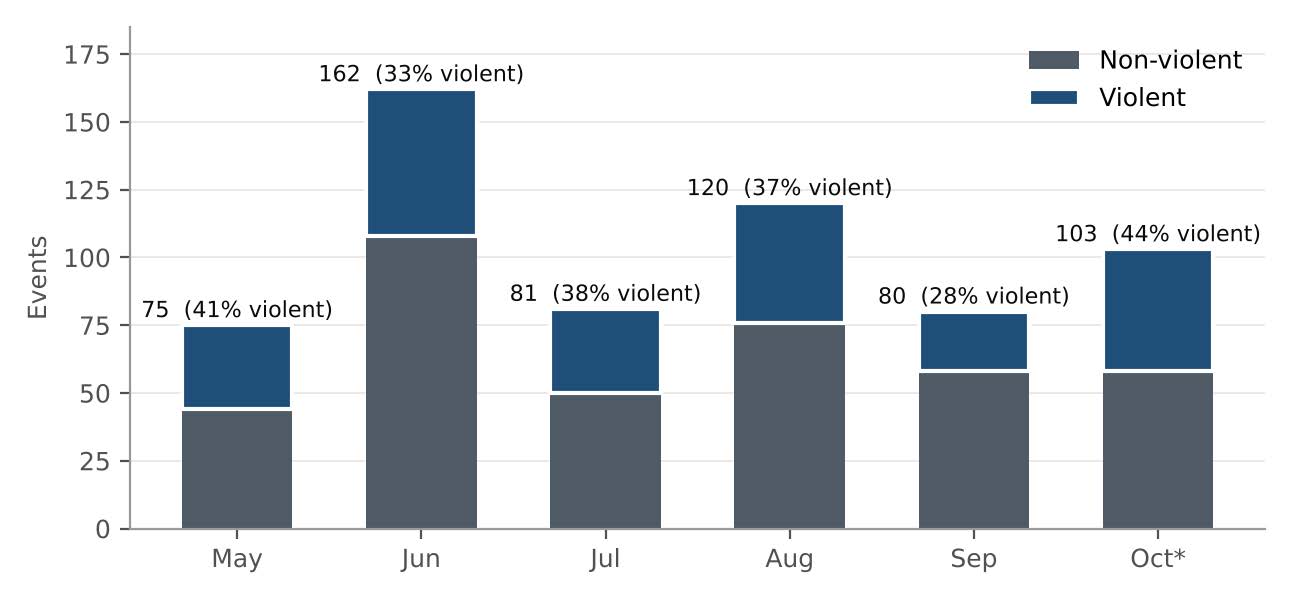
The PPVM records 621 events between May and October, 227 (37%) of them violent. Volume peaked at the June and August registration weekends. October had the highest violent share of the period (44%), driven by the anti-migrant resurgence and the final-campaign attacks.1
Where the deaths are
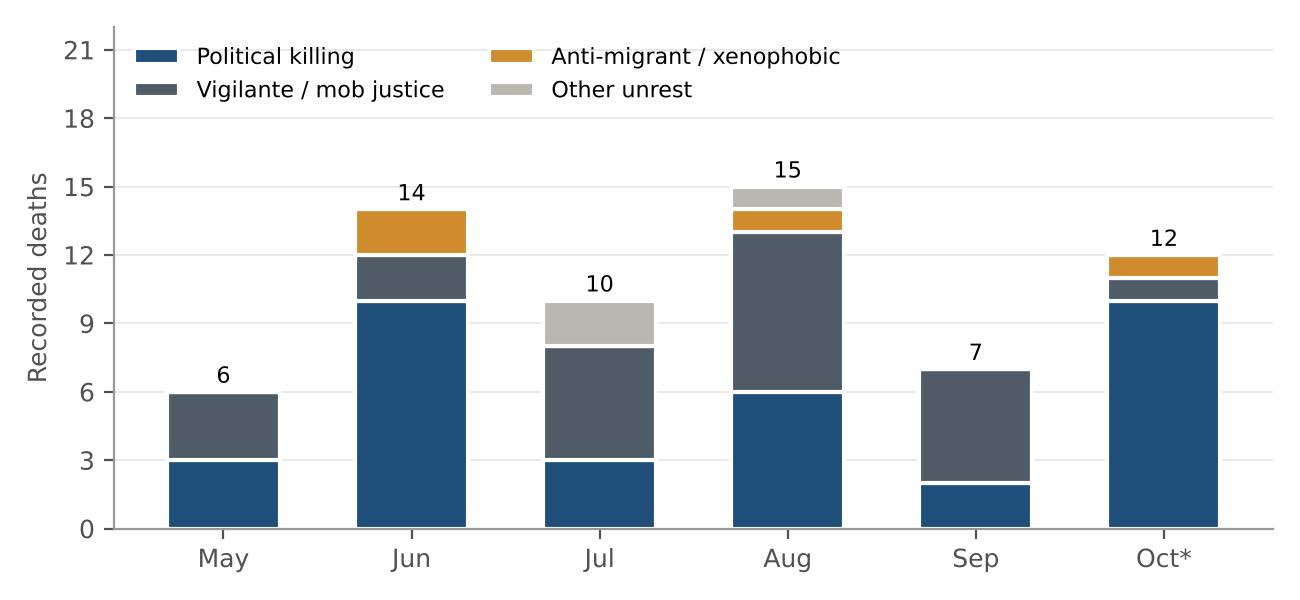
Deaths concentrate in political killings (34) and mob justice (23), not in protest. Four deaths were migrant-related, and three occurred in other unrest. Mob justice is not election-related but is the deadliest category after political killings: 23 deaths in 19 incidents across Limpopo, the Western Cape, the Free State and Mpumalanga, including four men burned to death in Dunoon on 23 August.
The anti-migrant mobilisation and the army deployment
Foreigner-related events fell from 39 in July to 12 in August and 5 in September. The October resurgence had a clear trigger. A September Home Affairs directive implementing a July Constitutional Court ruling on the Refugees Act led to long queues at refugee reception offices, amplified by false claims of a blanket amnesty. Anti-immigration groups blockaded the offices, and unrest spread into the Durban city centre and Soweto on 8 and 9 October. Home Affairs withdrew the directive on 9 October.12, 13
The PPVM records 21 foreigner-related events in October, 15 of them violent. On 22 October, a man was beaten to death in central Durban by a group that broke away from a march, the first march-linked death since 30 June.14 The President has employed 510 soldiers in KwaZulu-Natal from 9 October to 30 November to support the police during anti-immigration marches, at an estimated cost of R34.1 million. The deployment is not described as election-related.15, 16
On 28 October, the acting Minister of Police, Firoz Cachalia, obtained an interim interdict against the March and March protests in eThekwini. Police cited warnings of further protests and an alleged threat to burn down the refugee reception centre in Berea, as well as assaults, damage to property, forced business closures and the death of a foreign national during protests in the city centre. The interdict remains in force until the court decides, on 30 October, whether to make it final. Its full terms had not been published at the time of writing, and March and March had not commented.17 The order targets the movement as an organiser rather than individual participants, which is significant. It is, however, a civil measure: it restrains future protests but does not hold anyone to account for past conduct.
The mobilisation is now episodic and trigger-driven rather than continuous. Foreseeable triggers include a revised Home Affairs approach to asylum applications, renewed amnesty or voting disinformation, and any crime attributed to a foreign national in the lead-up to polling day.
Electoral process and candidate selection conflict
Election-coded events are concentrated almost entirely at the June (41) and August (40) registration weekends. Since then, conflict over the electoral process has appeared mainly as party-political protest over candidate lists, and in the killings themselves. The wards identified by IEC conflict coordinators during registration remain the best available guide to voting-day disruption.18 Across the dataset, the strongest predictor of violence remains legality: 75% of events recorded as ‘illegal’ (or where notification was not provided to authorities) were violent, against 1% of those recorded as ‘legal’.
4. Hotspots
Highest risk
eThekwini and the KwaZulu-Natal south coast combine the highest concentration of political killings with the anti-migrant movement’s organisational base. The KwaZulu-Natal midlands and north coast saw three IFP killings in 12 days and an attempt on a senior ANC figure. Ekurhuleni and Bekkersdal carry the Katlehong precedent of an attack on a group, and Ekurhuleni has a contested mayoral race.
High risk
Cape Town recorded the highest event volume nationally since August (56 events, 5 deaths), with Dunoon combining a candidate killing, a mob killing of four and the shooting at an anti-immigration gathering. Knysna recorded two fatal attacks on ANC figures in two days. The former Transkei combines the October killings with wards that repeatedly disrupted registration.
Watch
The Free State, where a DA candidate was killed in Zamdela, and the Limpopo ‘mob-justice belt’ record few events but high lethality.
5. Overall risk assessment
Table 1 sets out the main risks. The principal lethal risk on and around voting day is targeted and small-group armed attack on candidates, party agents, campaign teams and gatherings, rather than mass disorder.
Table 1: Risk assessment to 4 November and the post-election period
| Risk | Likelihood | Assessment |
|---|---|---|
| Targeted killings of candidates, councillors, agents and campaigners | High – near certain to continue | 26 fatal attacks and an October surge; arrests known in four. Risk extends to council formation and mayoral elections. |
| Armed attacks on groups engaged in political activity | High – new since August | Katlehong, Umgababa and Dunoon set the pattern; party agents and volunteers in transit are most exposed on 4 November. |
| Anti-migrant vigilantism and unrest | High – episodic | Rapid re-mobilisation around a concrete target in October, amplified by disinformation. |
| Mob justice killings | High – not election-related | 23 deaths in the period; same crowd mechanism as the Durban killing. |
| Disruption of voting | Medium-high – localised | Registration-weekend ward grievances remain unresolved. |
| Mass public disorder | Medium | Durban unrest of 8–9 October showed rapid escalation; the army deployment adds containment capacity but does not address targeted killings. |
| Violence over results and coalition formation | Medium-high | Based on this cycle’s pattern of killings at each decision point over office. |
Source: ISS assessment.
Three trigger conditions should be watched closely: 1) a killing with a clear partisan or cross-communal attribution; 2) results in closely contested or hung councils, which create identifiable winners and losers; and 3) a crime attributed to a foreign national that is amplified before it is verified.
Of three possible de-escalation indicators, only one has been partially met: arrests in political killings, in four of 26 cases. No anti-migrant organiser of door-to-door or blockade actions has been prosecuted, and no public mediation of ward-level or candidate-list grievances has been identified.
6. Prospects for violence tied to the electoral process
The risks set out above do not fall evenly across the election period. They shift as the process moves from special voting to polling, counting, results and the formation of councils. Each phase puts different people in harm’s way and targets them differently. Table 2 summarises the phases, and the sections below explain them. This outlook is an ISS assessment based on the patterns in the PPVM record, but it is not a forecast of specific incidents.
Table 2: Risk of violence by phase of the election period
| Phase | Dates | Main risks | Most exposed |
|---|---|---|---|
| Special voting | 2–3 November | Intimidation of election staff and home-visit teams; blockades of special voting stations in disputed wards; final attacks on candidates; disinformation about who may vote. | IEC staff, candidates, party agents in rural and peri-urban wards. |
| Election day and counting | 4 November (7am–9pm) and the night after | Blockades and staff removal in grievance wards; clashes between party agents; attacks on agents and candidates travelling after dark; disputes over results slips. | Voting stations in disputed wards; party agents; candidates in close contests. |
| Results and seat allocation | From 5 November | Protests over ward results and objections; reactions by losing candidates and their supporters; hung councils. | Losing ward candidates; IEC municipal offices. |
| Council formation | Within about 14 days of results | Targeted killings linked to speaker, mayoral and executive posts and coalition bargaining. | Councillors positioned for office in hung councils. |
| New council term | December onwards | Continuing attacks on councillors, as in the 2021–2026 term. | Ward councillors, especially in KwaZulu-Natal. |
Source: ISS assessment.
The two days before the election: special voting on 2 and 3 November
Special voting takes place on Monday and Tuesday, 2 and 3 November, from 8am to 5pm. About 2.6 million voters have been approved to cast special votes, and more than 600 000 home visits are planned, about 80% of them to voters aged 60 or older.19, 20 These two days carry distinct risks:
- Exposed election staff. Home-visit teams travel in small groups through communities with ballot material, often in rural and peri-urban areas with little police presence. During voter registration, IEC officials were assaulted, removed from stations or too afraid to enter in several provinces.18 Communities that used registration as leverage over local grievances may do the same with special voting, which involves fewer staff and less security than polling day.
- A last window for attacks on candidates. The final campaign weekend and the special voting days fall immediately after the deadliest fortnight of the cycle. Two candidates were shot at home in the last ten days of the period. Candidates in contested wards remain at risk until the polls close, and arguably more so once the outcome becomes clearer.
- Disinformation about who may vote. False claims that asylum seekers would be allowed to vote circulated during the October unrest, but the IEC has rejected them, and Home Affairs said it would refer the disinformation campaign to the IEC.13 There is a risk that anti-immigration groups attempt to ‘check’ voters’ nationality at or near voting stations. The eThekwini interdict and the army deployment in KwaZulu-Natal reduce but do not remove this risk.
- Overnight security of special votes. Special votes are cast before polling day, so ballot material must be kept secure for up to two nights. Any interference with it, or rumours of interference, could be used to contest results in close wards.
Election day: 4 November
Voting stations open from 7am to 9pm. About 29 million people are registered, and 136 790 candidates are contesting.19, 20 The risks on the day itself are mostly local and predictable:
- Disruption in grievance wards. Communities that blockaded registration stations over services, ward boundaries or councillors may try to stop stations from opening or force staff out. Registration-weekend incidents were largely bargaining by people who intend to vote, so they can often be resolved through quick mediation rather than force. The wards identified during registration are the best guide to where this will happen.18
- Friction between party agents. Party agents are likely to be present at most stations for a 14-hour day and throughout the counting. During registration, members of different parties clashed at party tables in Mpumalanga, the West Rand and Johannesburg. In wards where the contest is close or where killings have occurred, minor disputes can escalate.
- Attacks after dark. Most political killings in this cycle happened at or near victims’ homes, often at night. Polls close at 9pm, and counting continues into the early hours, so candidates and agents travelling home after the count are exposed. This is the period of highest risk for targeted attacks on election day itself.
- Disputes at the count. Results are counted and posted at each station. In close ward contests, disputed result slips can trigger on-the-spot confrontations.
Mass disorder on election day is unlikely. Large-scale violence would most likely follow a specific trigger, such as a killing with a clear partisan attribution or a rumour about foreign nationals voting, that spreads before it can be verified.
After the vote: results, seat allocation and council formation
Results are received, verified and announced through the IEC’s results operation centre in Midrand.19 The most dangerous part of the cycle may then begin. Once results are declared, municipal managers have 14 days to call the first council meetings, at which councillors elect a speaker, who then oversees the election of the mayor.21 In hung councils, this compresses intense coalition bargaining over mayoral and executive posts into a short period.
The pattern in this cycle is that killings follow the moments when office is allocated, namely registration, candidate selection and the final campaign. Seat allocation and council formation are the next such moments, producing identifiable winners and losers in specific municipalities. The risk does not end with council formation either. According to data released by the KwaZulu-Natal Premier’s office, 18 elected councillors were killed in the province during the term that began after the 2021 local elections.22
The army deployment in KwaZulu-Natal ends on 30 November, around the time councils convene. Police capacity, which has been stretched by elections, anti-immigration protests and other operations, will also be redeployed after the vote. That creates a gap at precisely the point where the risk of targeted killings is likely to rise again.
The most dangerous moments in this election may come after the vote, when councils elect speakers, mayors and executives. Security planning that stands down after polling day will miss them.
7. Conclusion
The data show that the people most at risk in this election are not those who march but those who stand for office, work for parties or lead local movements. They are killed at home, in their offices and while campaigning, by small armed teams, in a pattern that follows the electoral calendar. That pattern points beyond 4 November: seat allocation, mayoral elections and coalition bargaining will create the next set of winners and losers. Security planning that ends on voting day will miss the next wave.
8. Recommendations
Before and on 4 November
- Extend close protection and threat assessment to ward candidates in contested wards and to party agents in transit, prioritising eThekwini, Bekkersdal, Knysna and Katlehong.
- Advise parties to avoid unescorted door-to-door teams, late-night returns and publicised home addresses, and to report threats to the Political Killings Task Team immediately.
- Treat memorials and funerals of political victims as high-risk gatherings requiring armed protection.
- Maintain heightened deployment at refugee reception offices in Durban, Pretoria, Gqeberha and Cape Town, police blockades of those offices as unlawful obstruction, and enforce the eThekwini interdict against March and March protests consistently if it is made final.
- Use the army deployment in KwaZulu-Natal to free police capacity for protecting candidates and investigating killings.
- Use the registration-weekend ward list as the early-warning layer for voting-day disruption, and provide escorts for special-vote home-visit teams in those wards on 2 and 3 November.
- Act quickly against any group that attempts to check voters’ nationality at or near voting stations, and counter disinformation about who may vote.
- Plan for agents and candidates to travel home safely after counting ends on election night.
After the results
- Sustain protection of mayoral, speaker and executive candidates in hung councils for at least the first month after results. The army deployment ends on 30 November, around when councils convene; any extension or handover should be planned now.
- Publish an updated Political Killings Task Team count by case, and clarify whether civic-movement leaders such as Andile Somgxada and Douglas Thusini fall within its scope.
- Conclude prosecutions in the cases with suspects and publicise the outcomes.
- Pursue the organised crime and extortion networks identified by GI-TOC and the Moerane Commission.3, 4
Annex A: Political killings recorded, May–October 2026
Table 3: Register of political killings (26 attacks, 34 deaths)
| Date | Victim(s) and role | Affiliation | Municipality | Deaths | Setting | Arrest |
|---|---|---|---|---|---|---|
| 05 May | Thumeka Bikwana, councillor | Not stated | Emalahleni, EC | 1 | Home | – |
| 27 May | Mokoena Letsie, shack dwellers activist * | Civic | JB Marks, NW | 1 | Not recorded | – |
| 28 May | Mbuso Mthimkhulu, PR councillor | IFP | Rand West City, GP | 1 | Community meeting | – |
| 13 Jun | Monica Dube, election coordinator * | EFF | City of Tshwane, GP | 1 | Home (break-in) | Charged |
| 13 Jun | Wonele Gontshi, branch elections coordinator; Ngawonke Bulala (died later) | ANC | Mhlontlo, EC | 2 | Public place | – |
| 15 Jun | Thembalethu Zondo, ward candidate | DA | Okhahlamba, KZN | 1 | Not recorded | – |
| 20 Jun | Sicelo Mleve, ward councillor | ANC | Nelson Mandela Bay, EC | 1 | Constituency office | 2 arrested |
| 20 Jun | Sinovuyo Dyokwe, by-election candidate | DA | City of Cape Town, WC | 1 | Returning from registration | 1 arrested |
| 20 Jun | Two party volunteers | MK Party | Rand West City, GP | 2 | Returning from registration | – |
| 20 Jun | Leon Ngcikwe, ward candidate | BOSA | City of Cape Town, WC | 1 | End of registration day | – |
| 21 Jun | Vukani Majozi, BEC member | ANC | eThekwini, KZN | 1 | Home | – |
| 04 Jul | Andile Somgxada, Gauteng leader | March and March | Ekurhuleni, GP | 1 | Home driveway | – |
| 11 Jul | Aaron Makola, member | EFF | Victor Khanye, MP | 1 | Abducted | Unconfirmed |
| 31 Jul | Douglas ‘Mfene’ Thusini, activist | Civic / MK Party | eThekwini, KZN | 1 | Near home | – |
| 06 Aug | Sibusiso ‘Khekhe’ Khwela, ward councillor | ANC | eThekwini, KZN | 1 | Constituency office | – |
| 07 Aug | Nelisile Xolo, branch chair / SACP district treasurer | ANC / SACP | Ray Nkonyeni, KZN | 1 | In vehicle | – |
| 19 Aug | Aubrey Tsengwa, ward councillor, former mayor | ANC | Knysna, WC | 1 | Street, night | – |
| 19–20 Aug | Mandla Matiwane, former councillor; Mandla Tyololo, member | ANC | Knysna, WC | 2 | In vehicle | – |
| 27 Aug | Khethelo Mdluli, councillor and candidate | IFP | uMlalazi, KZN | 1 | Home | – |
| 01 Sep | Lucky Sokhela, ward candidate | IFP | uMshwathi, KZN | 1 | Arriving home | – |
| 08 Sep | James Mabaso, PR list candidate | IFP | Msinga, KZN | 1 | Home | – |
| 13 Oct | Four ANCYL members returning from a memorial | ANC | Ekurhuleni, GP | 4 | Leaving memorial | Charged |
| 13 Oct | Headman and his mother * | Traditional | Mnquma, EC | 2 | Homestead | – |
| 15 Oct | Two ANC campaigners | ANC | eThekwini, KZN | 2 | Door-to-door campaign | – |
| 23 Oct | Ernest Fipaza, ward candidate (former ANC councillor) | SACP | Mbhashe, EC | 1 | Home | – |
| 26 Oct | Thulani Mbana, ward candidate and caucus leader | DA | Metsimaholo, FS | 1 | Home | – |
Source: ISS Protest and Public Violence Monitor; ISS coding. * Borderline inclusion. ‘Arrest’ shows publicly reported arrests or charges only; ‘–’ means none found, not that none exist.
Data and methodology notes
- Classification. Political-killing status, victim role and setting are ISS judgments from event descriptions. GI-TOC classifies the Dyokwe killing as organised crime.
- Record discrepancies. The Thusini record gives two first names (Douglas and Gideon); Somgxada died five days after the attack; the Mdluli record is dated to his death rather than the attack; reports describe Mbana as a ward candidate and former councillor; later reports put the Katlehong wounded at three rather than five.
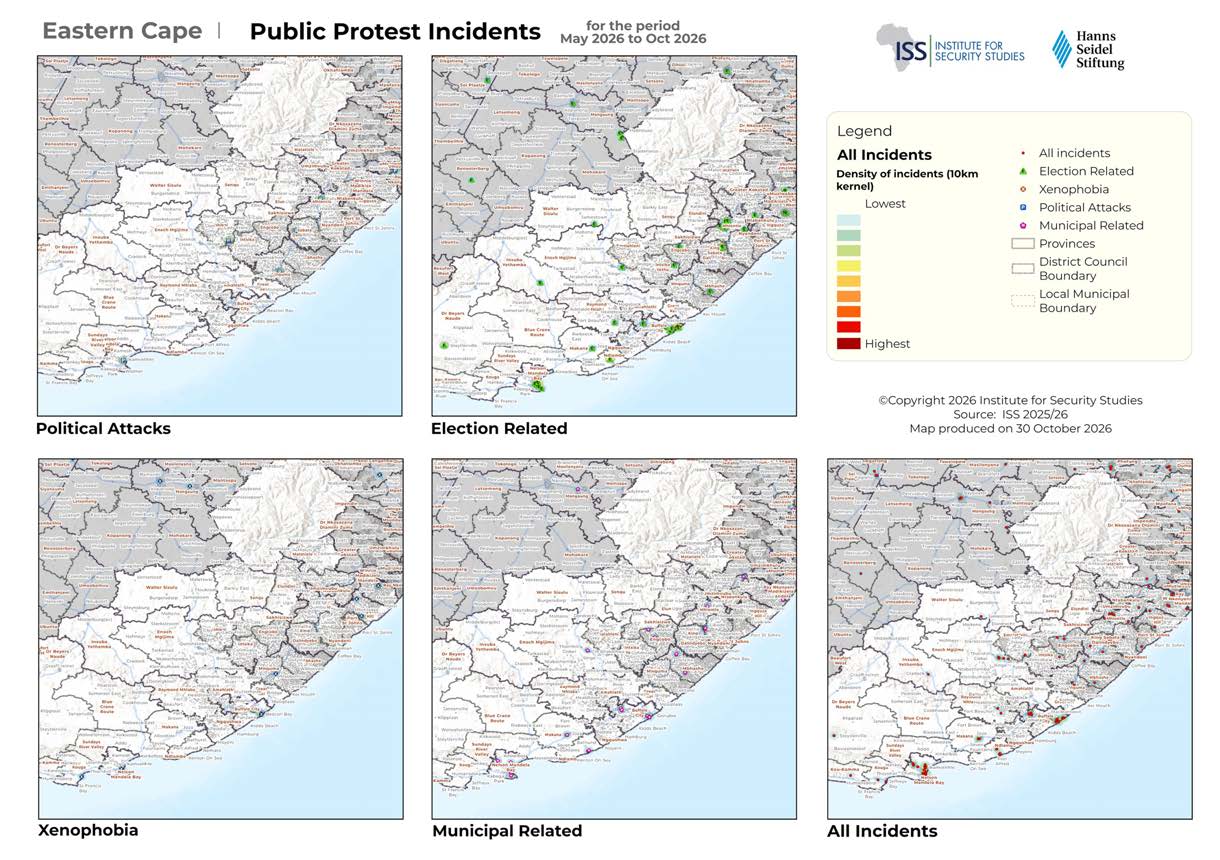
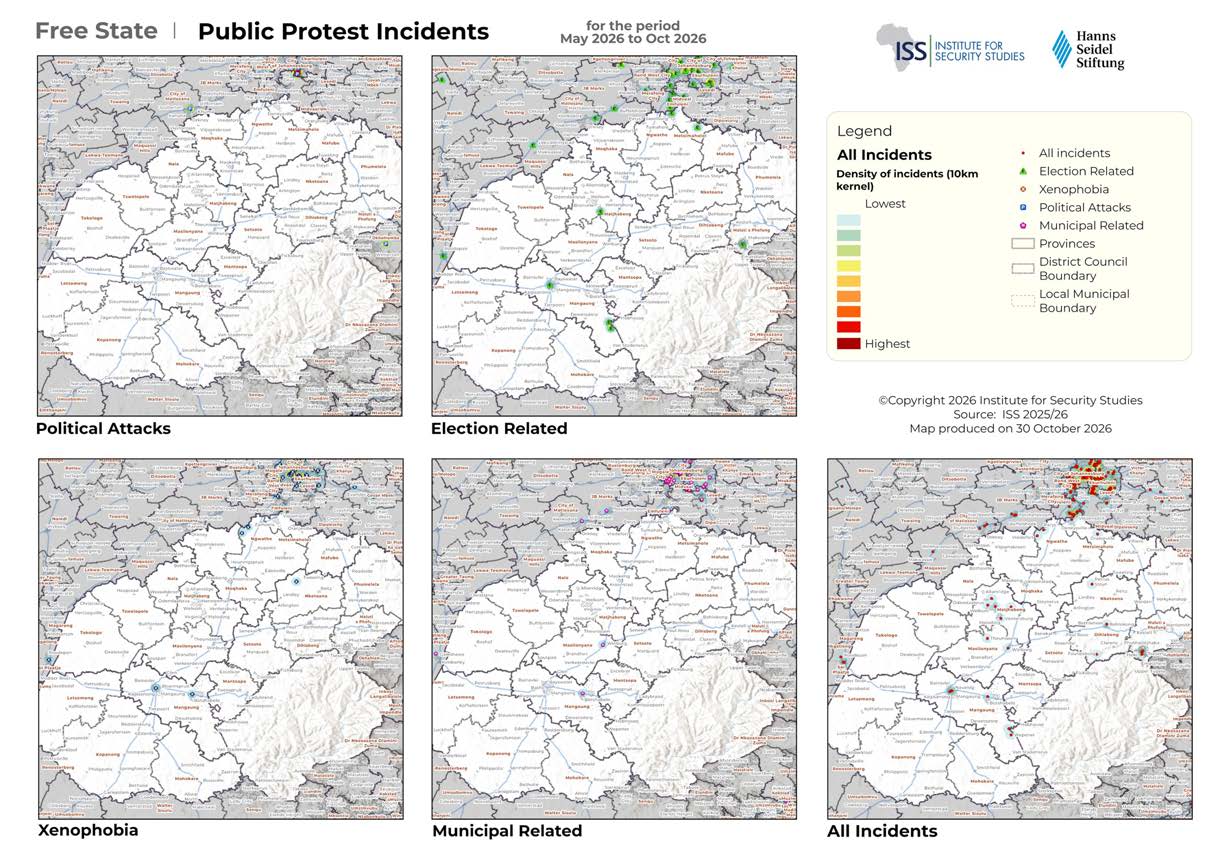
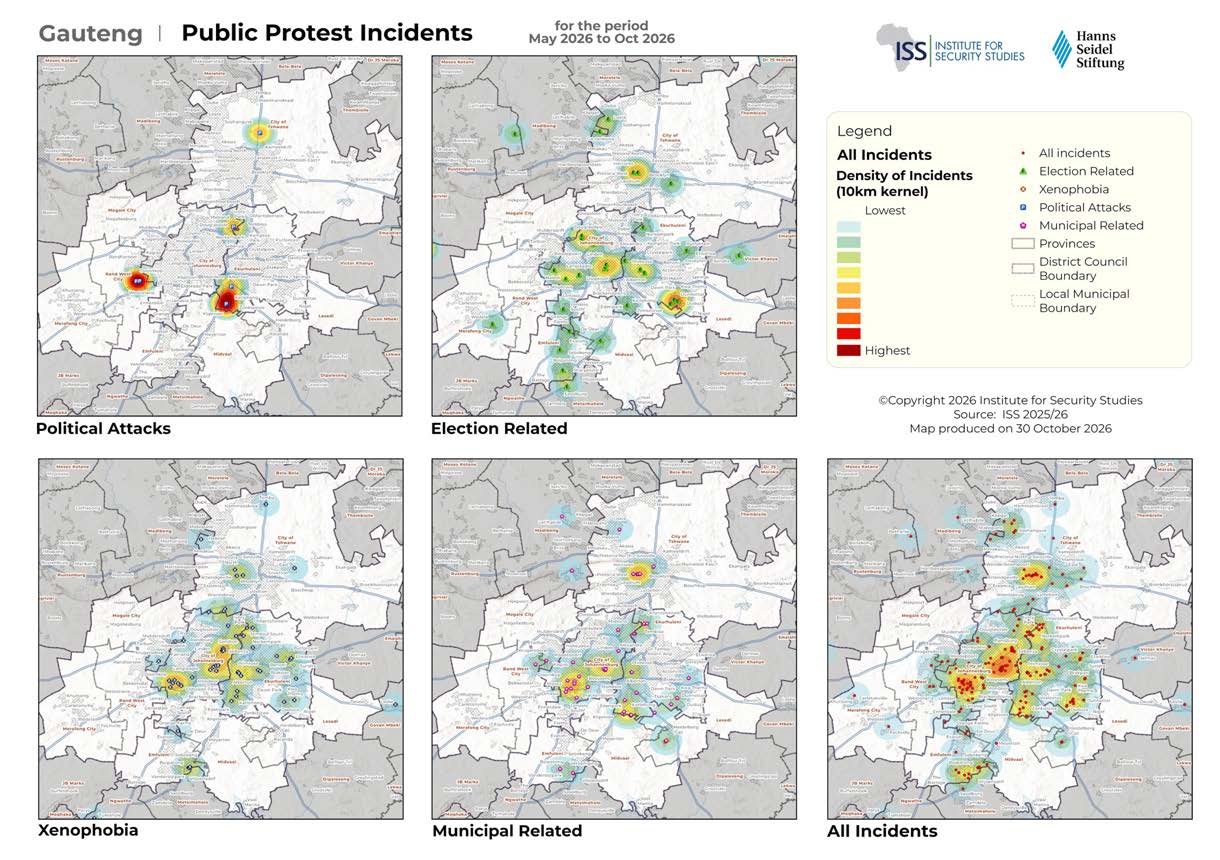
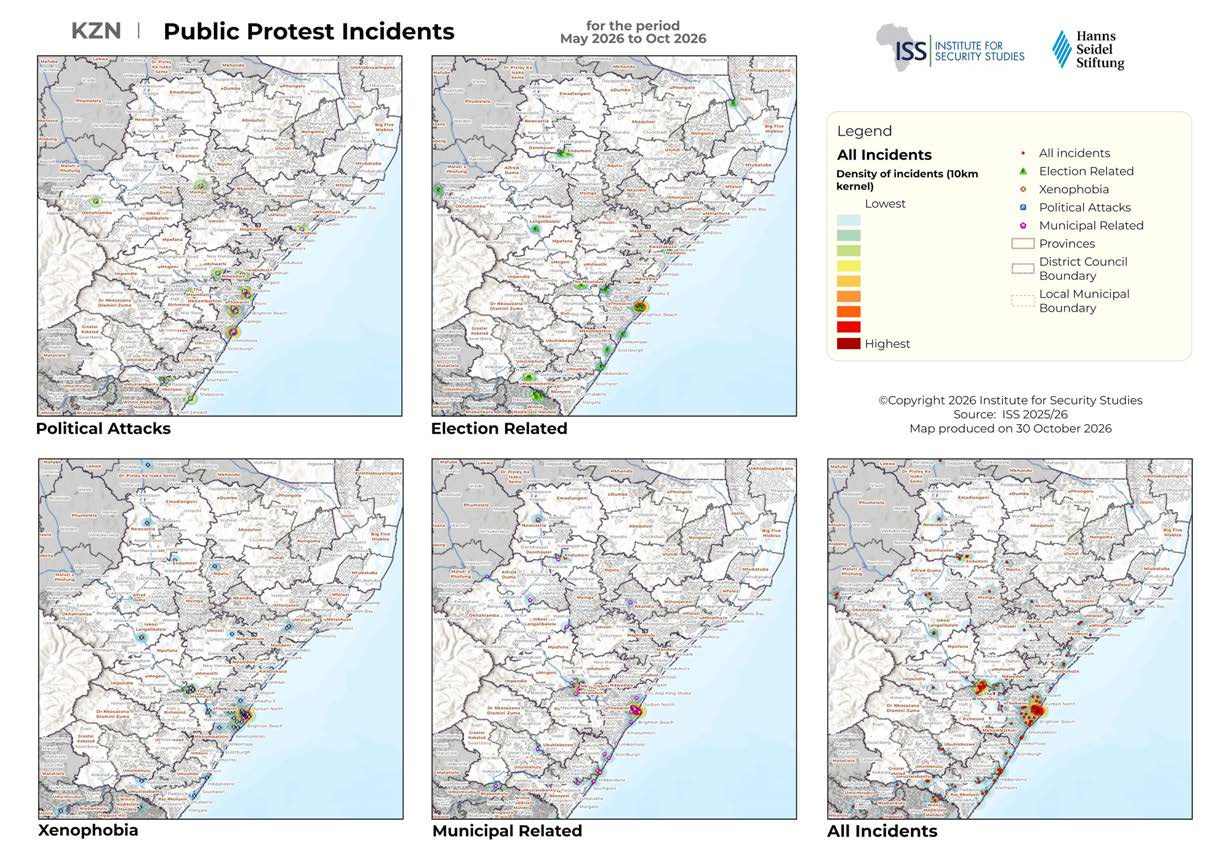
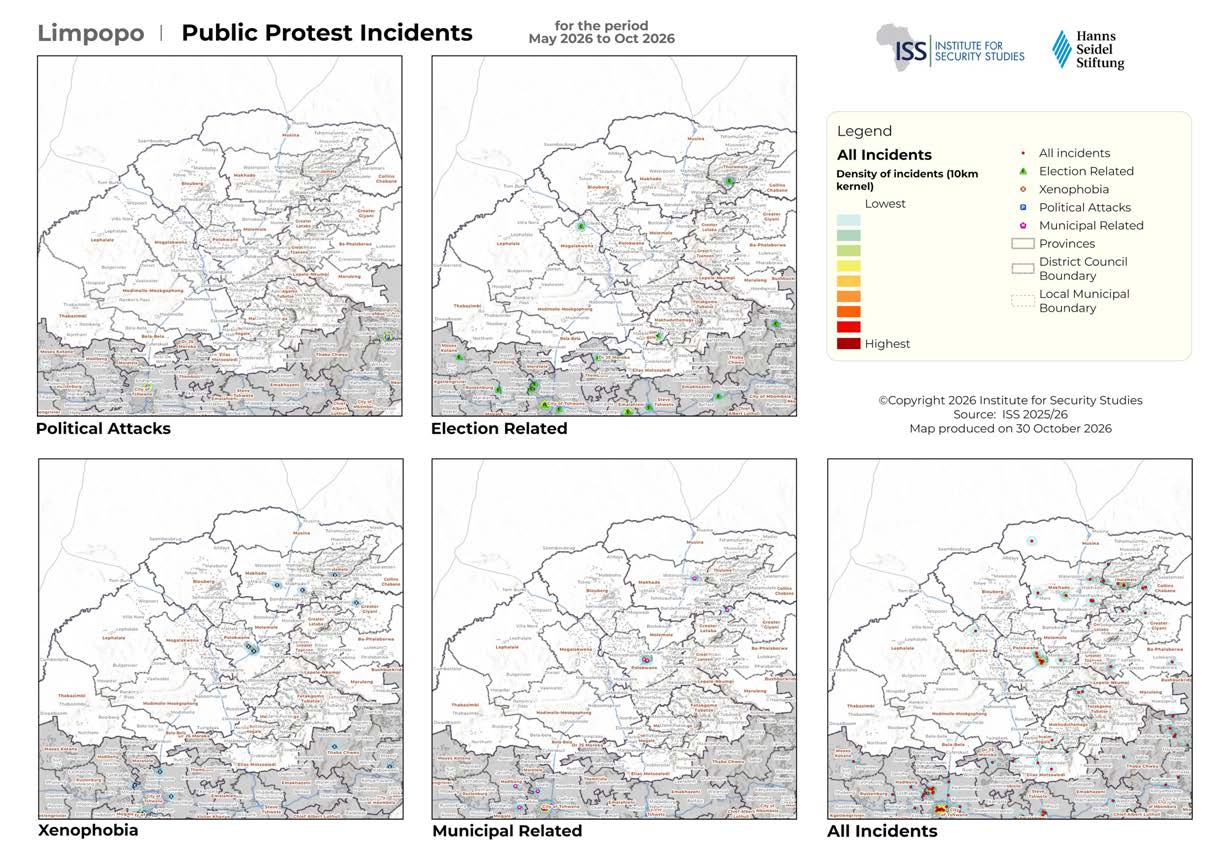
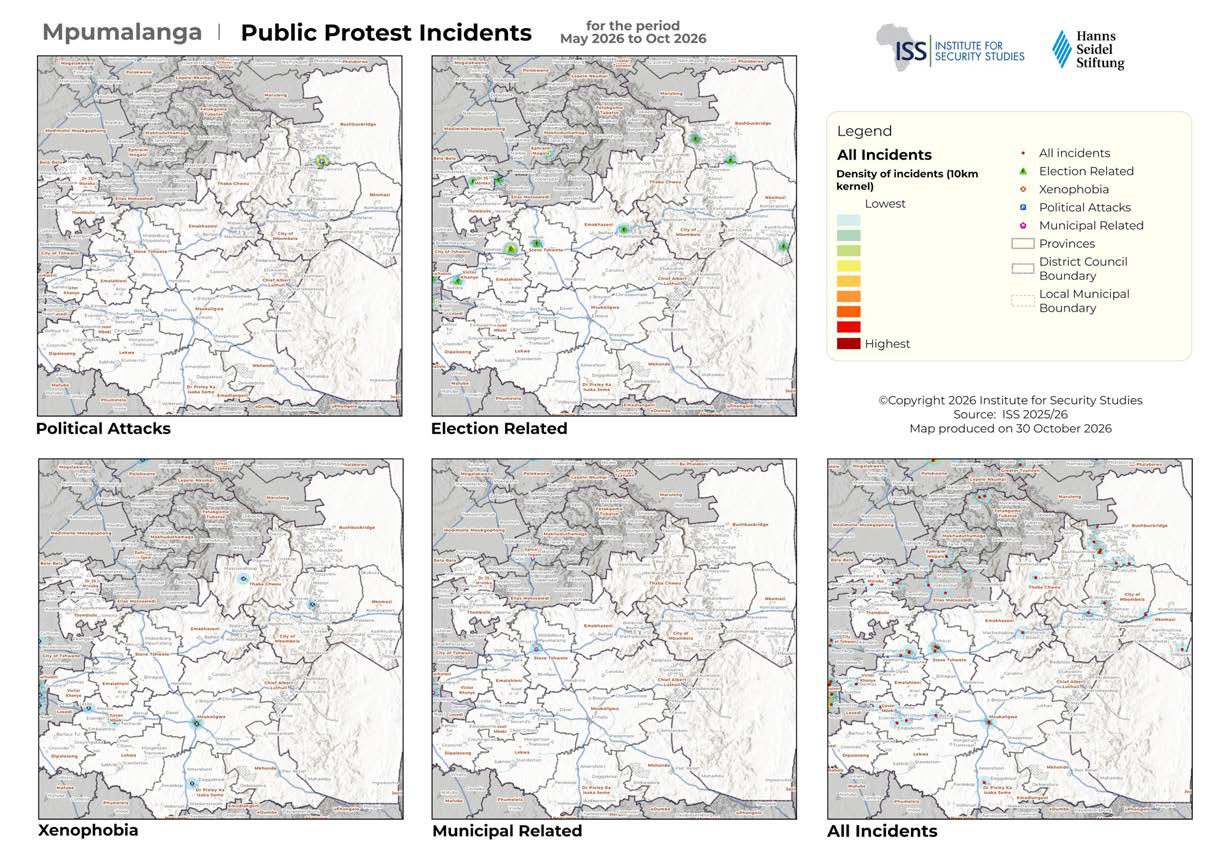
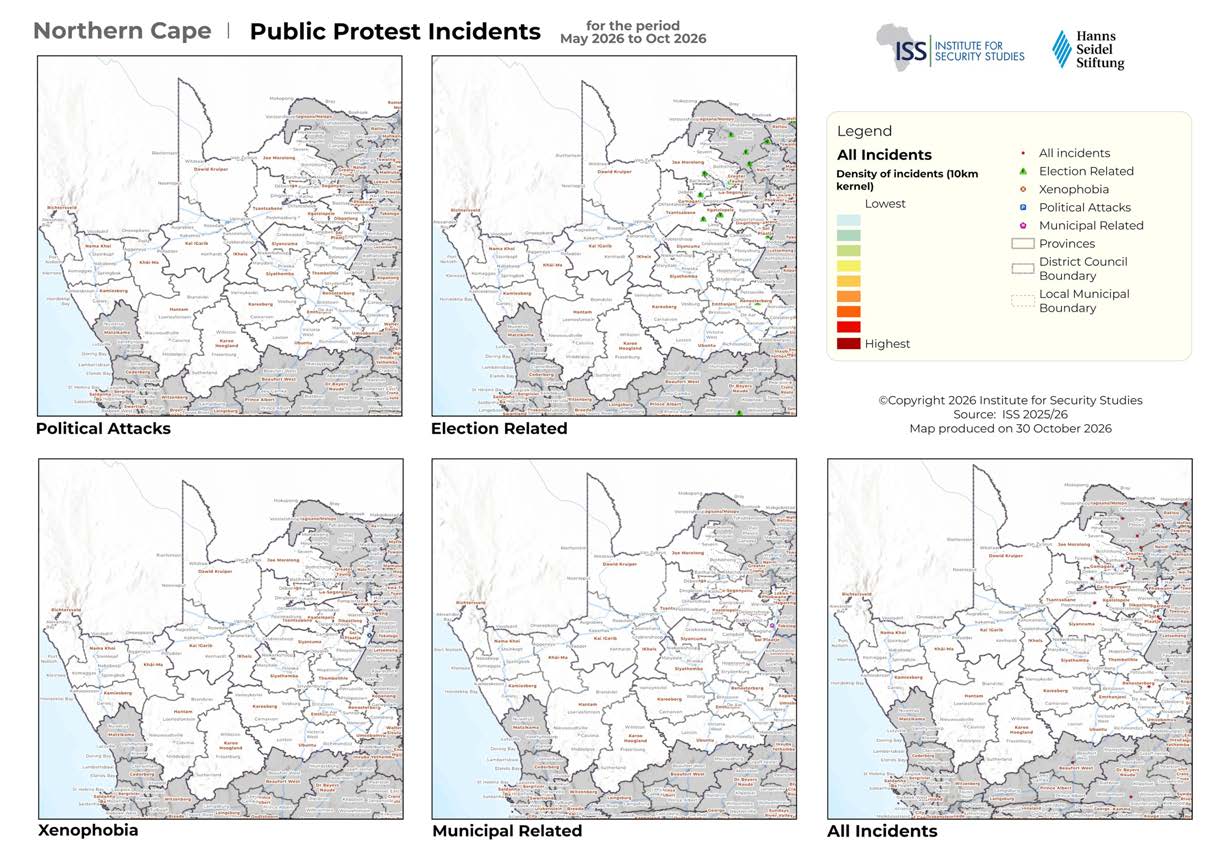
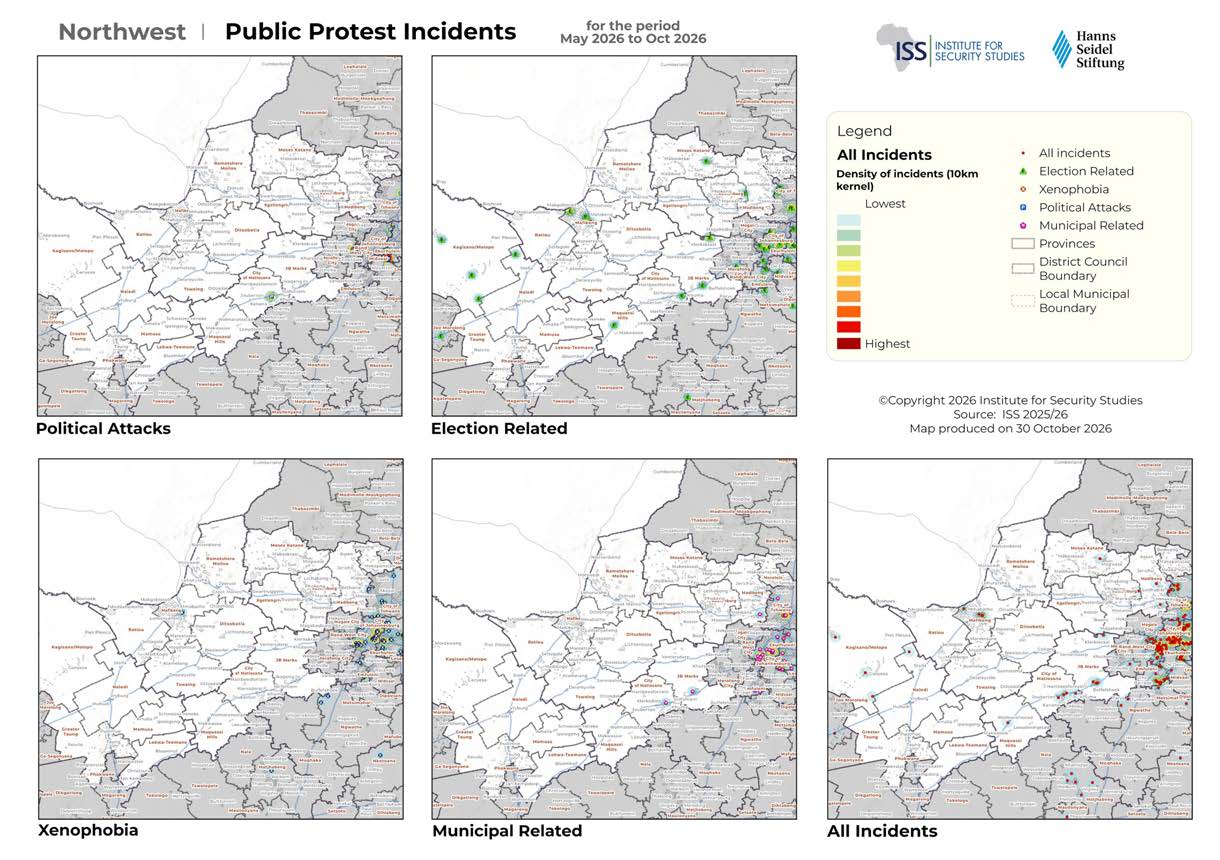
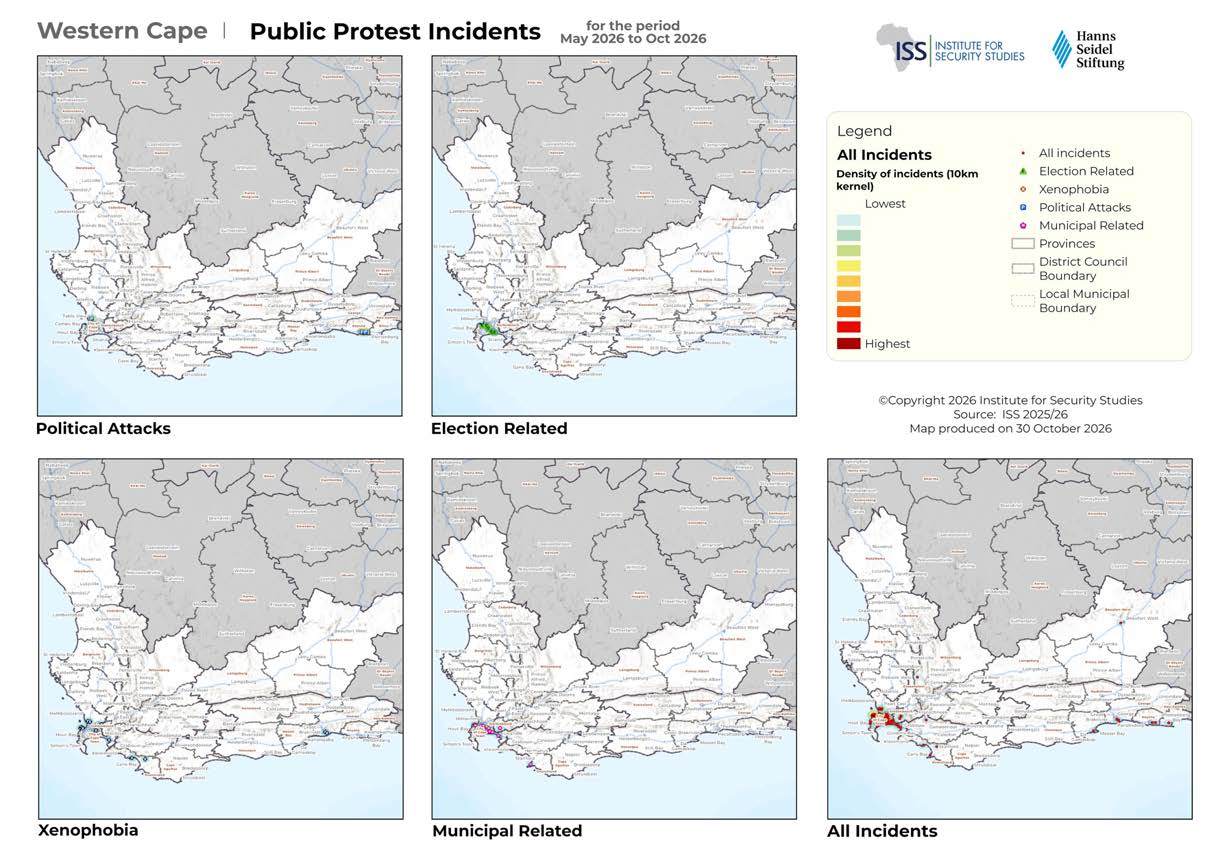
- Maps. Annex B reproduces the ISS provincial incident maps for May to October 2026. Their categories follow PPVM event coding, so their political-attack layer includes non-fatal incidents.
- Verification. All figures from the cleaned dataset were checked against their source records on 30 October 2026. AI was used to verify external claims against the cited sources.
Annex B: Incidents captured by province, May–October 2026
The maps show the location and density of incidents recorded in the ISS Protest and Public Violence Monitor between May and October 2026, by province. Each sheet shows political attacks, election-related, xenophobia-related and municipal-related incidents, and all incidents with a 10 km density surface. Map categories follow the PPVM event coding and are not identical to the register of political killings in Annex A. Source: ISS 2025/26; maps produced 30 October 2026.
Select a province to display its five incident layers and legend, then select the image to enlarge it. Maps are reproduced from the original ISS factsheet.
Map 1: Eastern Cape
Map 2: Free State
Map 4: KwaZulu-Natal
Map 6: Mpumalanga
Map 7: Northern Cape
Notes and references
- ISS, Protest and Public Violence Monitor, cleaned extract to 28 October 2026, crimehub.org/protests. The figures are ISS calculations for 621 active records, dated from 1 May to 28 October 2026.
- TimesLIVE, DA ward candidate shot dead at home ahead of local elections, 27 October 2026. Police said it had not been confirmed whether the killing was politically motivated.
- Moerane Commission of Inquiry into the Underlying Causes of the Murder of Politicians in KwaZulu-Natal, Report, KwaZulu-Natal Provincial Government, 2018.
- J Rademeyer, Ballots and bullets: targeted killings and South Africa’s 2026 local government elections, Global Initiative Against Transnational Organized Crime (GI-TOC), 2 October 2026. GI-TOC notes that its database almost certainly undercounts, that 51% of incidents rest on a single source and that more intensive collection in 2026 may overstate the increase over earlier years.
- Daily Maverick, Girl, 11, who survived mass shooting still has bullet lodged near her spine, 16 October 2026.
- TimesLIVE, Two more ANC Youth League members die after Katlehong shooting, 14 October 2026.
- SAnews, NATJOINTS assures safe, peaceful environment ahead of Local Government Elections, 7 August 2026.
- The Citizen, ‘He aimed for the head’: ANCYL slams ‘trigger-happy’ suspect, alleges political motive in Katlehong shooting, October 2026.
- EWN, Alleged Katlehong shooter faces four murder charges, expected to apply for bail next week, 15 October 2026.
- EWN, Katlehong mass shooting: accused abandons bail application, 22 October 2026.
- EWN, ANC Youth League seeks IEC clarity on murder-accused Fani Sibeko’s candidacy, 22 October 2026.
- EWN, Home Affairs withdraws intake of asylum applications directive after violent protests, 9 October 2026.
- Business Day, Refugee policies to be reviewed after court ruling sparks confusion at reception centres, 8 October 2026.
- EWN, 5 people in for questioning over murder of foreign national in Durban, 23 October 2026.
- The Citizen, Ramaphosa deploys 510 soldiers to KZN amid anti-immigrant violence, 27 October 2026; SABC News, 510 soldiers deployed to KwaZulu-Natal to support police, October 2026.
- defenceWeb, Soldiers activated for possible KZN anti-immigrant marches, 27 October 2026.
- eNCA, Interim interdict against March and March protest granted, 28 October 2026.
- ISS Justice and Violence Prevention Programme, Assessment note: incidents captured by IEC conflict coordinators over the June and August 2026 voter registration weekends, internal report, 13 August 2026.
- EWN, IEC gears up for local government elections as 2.6m voters set to cast special ballots next week, 28 October 2026.
- SAnews, Ready to vote? Know what to expect on Election Day, October 2026. SAnews separately reported that 136 790 candidates were cleared to contest the elections (16 September 2026) and that 2.65 million special vote applications were approved (14 October 2026).
- South African Government, Municipal managers have 14 days within which to call the first council meetings, 16 August 2016. The statement refers to the 2016 local elections; the same 14-day requirement is assumed to apply in 2026.
- Briefly News, Thamsanqa Ntuli confirms 18 KZN councillors have been killed since 2021 local government elections, 7 August 2026. The figure is attributed to data released by the KwaZulu-Natal Premier’s office.